
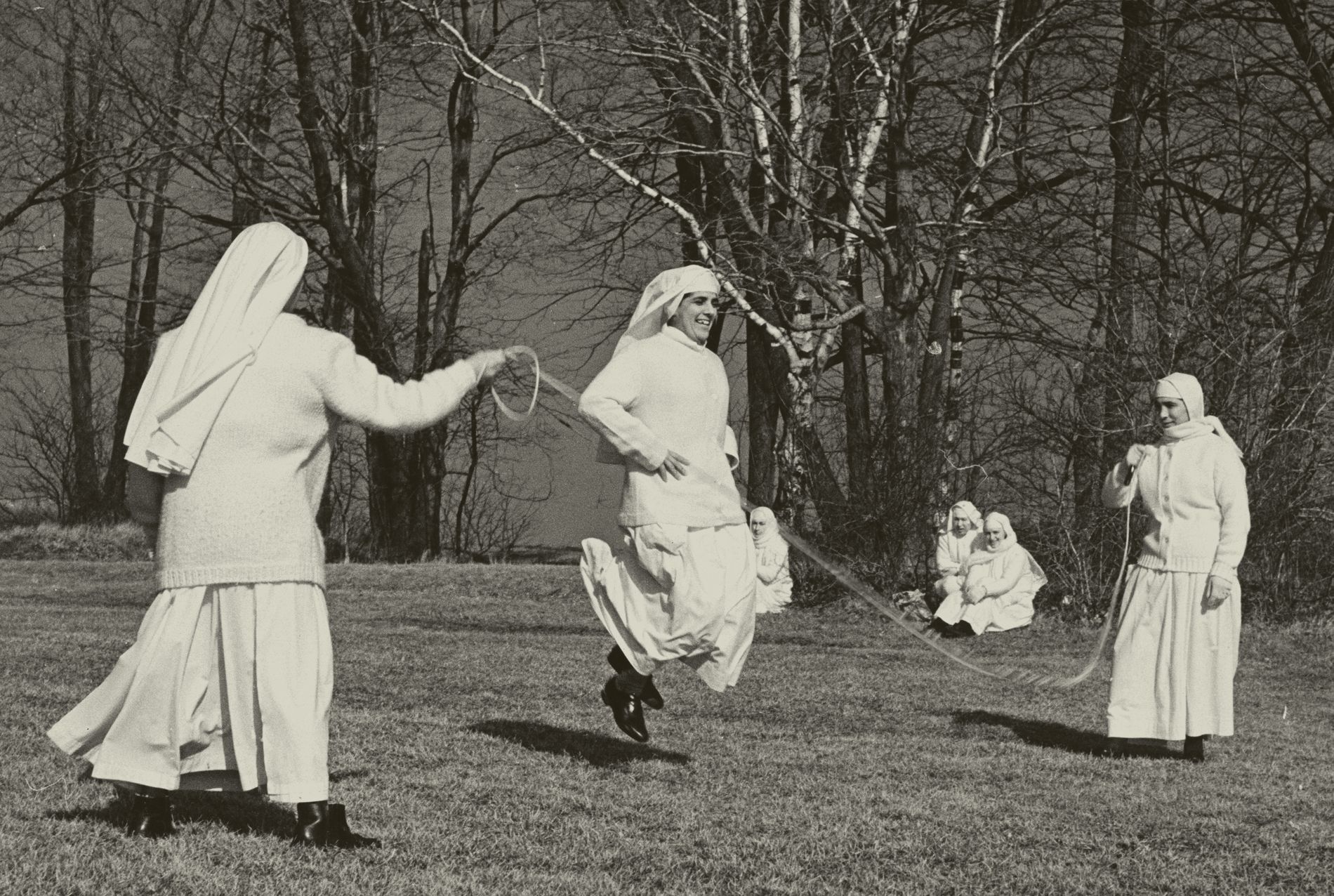
Force of Habit

This article was originally published by The Globe and Mail on April 19, 2019.

The nuns at Our Lady of Mercy could be ruthless.

I vividly remember the day Sister Kateri decided to announce each student’s I.Q. score to our Grade 5 class. Without warning. And while mine ranked second highest, I cringed when I was called up to the blackboard afterward to solve a math problem in what seemed to my nine-year-old mind to say: “See, this is what those with a higher I.Q. can do!”

Ugh. I shrank back into my seat, embarrassed by my participation in an exercise to make my classmates feel less than.

Our Lady of Mercy was a convent school in Orchard Park, New York, meaning it housed both the school and the convent. To the right of the statue of Mother Mary was the school; to the left, the convent.

I often sneaked around the convent side, peering into empty rooms amidst the deafening silence coming from that side. What did the nuns do here? Most rooms had coffee tables surrounded by wooden chairs and small sofas upholstered in drab brown fabric. The religious art and crucifixes that adorned the walls bordered on the macabre. I wondered what kinds of conversations happened there. Did they talk about normal stuff or did they just pray? Did they ever play cards, listen to music, laugh?

Realizing that my extended washroom break might get me into trouble, I scurried back to my classroom to face the next dreaded task pressed upon me to perform.

Whether or not Sister Kateri had anything to do with my eventual abandonment of Catholicism or any other religion is unclear to me. But by the time I was 10 years old, I confronted my father with a firm belief that people only believe in God because they fear death. I asked him to end the torture of my elementary Catholic school education in favour of application to the private school of my choice in the city.

My father obliged, though I don’t think he had much choice. I switched schools, discovered Freud, and enjoyed some concrete validation of my 10-year-old insight.

I came to Toronto to study psychoanalysis. A staunch Freudian at the ripe age of 17, I was adamant that any belief in God could only be explained in terms of humanity’s need for something beyond this life to hang our hopes on. This life couldn’t be it. That would be too devastating to swallow. Moreover, by assigning to God all of our greatest attributes, the “believers” seemed to be saying, hey, someone got it right, even if we didn’t. And He forgives us. And even better, if we’re not too bad, we might get a special place up there, beside Him. (Notice I’m using capitals, just in case.)

But despite all my precocious cynicism, critical thinking, and studies, I remain fascinated by nuns.

Growing up, my mother’s family were devout Catholics. My grandmother would routinely entertain priests for dinner at my grandparents’ house, with her usual spread of Italian-American delicacies: pasta in a homemade tomato sauce, bruscoli, sausages, stuffed peppers, fresh bread from the local Italian bakery. The wine, in bottles with straw casks, would flow liberally with the conversation.

I was so impressed by my grandmother’s allegiance to these priests that I actually wondered if she might be having an affair with one or more of them. Or at least fantasized about it. When I was in Grade 10, I wrote a short story about her relationship to these priests (which, I should say, won me top prize in the short story contest at my school).

I saw up close how the priests got all the acclaim. They were wined and dined by parishioners, like my grandparents, on a weekly basis. They had cars, money, invitations to events, tickets to the opera, vacation plans.

Yet nuns seemed entirely absent from parishioners’ appreciation – or anyone else’s appreciation for that matter. They vowed a life of poverty, chastity, and obedience, yet they worked hard – in hospitals, schools, orphanages, missions.

Some historians, like Heidi MacDonald, dean of arts at the University of New Brunswick at St. John, claim that 40 per cent of our Catholic schools and hospitals were built on the backs of nuns between the late 19th and 20th centuries. But that contribution to the Canadian work force and economy has been deeply under-valued over the past century and a half in large part because Census Canada never accurately accounted for their work in their enumerations.

Nuns can be found in both Christian and Buddhist religions, but the vast majority in Canada have been Roman Catholic and affiliated with the schools and hospitals that served about 40 per cent of the population who identified with that denomination between 1871 and 1961, as noted by Ms. MacDonald.

The Ursulines were the first order of nuns to arrive in Canada in 1639, led by Marie de l’Incarnation. They established a convent in Quebec and started the first school for girls in North America. Their students were Indigenous and French girls. The Ursulines eventually spread their work West and as far south as New Orleans. I was lucky enough to visit the historic complex in the French Quarter which was a former site of the Ursuline Academy and now stands as a museum to commemorate their work not only in establishing the first Catholic school for girls in the United States in 1727, but in running an infirmary for the orphanage also housed within their convent. The current building that houses the Ursuline Academy is a few blocks up the street from the Old Ursuline Convent Museum and remains the oldest school for girls in the United States.

I ended up a producer in film. A few years ago, I pitched an idea about nuns to a major Canadian broadcaster. I had interviewed three nuns for this pitch, all of whom had fascinating stories about why they had chosen to enter the convent.

It seemed unfathomable to me that, despite the depravity in the world today, anyone could still see it fit to grant humanity that kind of devotion, and so I asked them the same question: “Where do you find such faith in humanity in this day and age?”

One said she felt a calling while acting in a production of the Dan Goggin musical Nunsense. And she needed to pursue that calling. Another intimated that, no matter the state of the world, there must be some who have faith both in humanity’s promise and in the effort to help those in need around the world. She turned down a marriage proposal in a three-year relationship in favour of a marriage to God and servicing those in need.

But who does this anymore?

Well, it turns out that, despite a steady decline in the number of women joining the religious life between 1965 and about a decade ago, some orders are seeing a rise in women choosing the conventual life.

Over the past year, I’ve witnessed a group of nuns, on several occasions, enjoying the beach in my Toronto neighborhood. The first time I observed them, they were running along the sand, their habits fluttering in the wind, giggling like school girls under the setting sun.

This image of them was so bracing that I stopped to watch them for a few minutes, while trying to be discrete about my spying on them. They appeared other-worldly: Beacons of peace and days long gone by. They were the very essence of hope – in humanity. That they still existed in this world was anachronistic and marvelous all at the same time.

After a little digging, I figured out that the order of nuns I keep seeing on the beach are the Sisters of Life, a very traditional order of nuns that chooses to wear full habit all of the time. The Sisters of Life is one such order that is seeing rising numbers of women joining. Their order more than doubled in size between 2006 and 2016. And there seems to be a trend with orthodox orders gaining momentum in increasing size. The Dominican Sisters of Mercy, a conservative order based in Ann Arbor, Mich., has recently expanded to Austin, Texas. Founded in 1997, they now have more than 120 sisters whose average age is 30.

Yet despite the growth and contributions they’ve made to teaching, hospital work, institutionalized social work, and missionary work for the past four centuries or so, nuns continue to play second fiddle to priests. Not only are they not allowed to be paid directly for their services – their paychecks go to the congregation – but they live in poverty, unlike the priests, who enjoy many accoutrements of life.

Nuns tend to stay out of trouble, too. And I would venture to say that anyone who still believes in the sanctity of the Catholic church might as well credit the nuns for their faith. Some priests sure let everyone down.

In pondering anyone’s motivation to join the religious life and to remain devoted both to God and to those in need, despite the dire state of the world and its increasing secularization, it occurs to me that there is something to be said for sheltering oneself from the drudgery of daily news. We are bombarded by evidence of a declining culture obsessed with empty celebrity and the pursuit of materialism, poisoned by political partisanship, marked by abuses of our most valued institutions – our courts, our legislatures, the very foundations of our democracy. Turning on the news on any given day is demoralizing, infuriating, and just plain depressing.

The nuns sure seem to have it right. Turn off the news. Focus on the contemplative life, a life full of meaning, goodwill and service. Live actively, not reactively. Focus not so much on why there is so much turmoil and suffering in the world but, rather, on how you can make it better. How you can contribute to the healing, whether locally or abroad. Nuns don’t concern themselves with trivialities – they’re much more concerned with who is in need today, and how they can serve.

Perhaps if we all adopted this kind of single-mindedness and disregard for who is to blame, we’d all get along better. The nonsense of the world would be replaced by nunsense. And I’m guessing we’d all be a lot better off.

And while I know very well that this utopian dream is never going to happen, it begs both consideration and considerable appreciation of their service. Not that they expect any thanks. The charitable work that nuns contribute is selfless, pure and not expectant of any reward – the very essence of virtue.

So my hope is that the next time you cross paths with a nun – on the street, in a grocery store, on the beach – you will stop to appreciate that you have been blessed. Not only by crossing paths with her, but by her presence in your world.


Jillian Michaels’ Maximize Your Life Tour: A Kick in the Ass

“The ones who mind, don’t matter. The ones who matter, don’t mind.”
-Dr. Seuss

Jillian Michaels stormed the stage of the Sony Centre in Toronto Tuesday night in her signature powerhouse-even-at-5’3” style – the final show of her “Maximize Your Life” tour. The quote from Dr. Seuss, which she referenced late in the evening, underpinned one of her most salient points of the night: when we are redefining our own truth (aka refusing to be sheep in life), we will elicit adversity from various people (said sheep). Our responsibility to ourselves is to differentiate between those who mind our path and those who do not. All those who mind should be booted off the island.

Very big and truthful words.

I’ll get back to Dr. Seuss. There was more to the evening.

Her show was divided into two segments, the first dedicated to nutrition and exercise, not surprisingly, the second half to “the self,” our emotional and psychological wellbeing – what holds us back, what we need to change in order to live a full life. That’s usually where I tune out, ever suspicious of anyone purporting to be a self-help expert. But Jillian Michaels has always struck me as pretty legit – at least as a personal trainer, so why not as a life coach?

Let’s start with the first half. Ms. Michaels credited her international stature as the premiere leader in all things fitness to her formula: “eat less, move more.”

And yes, she was the first to point out the “unoriginality” of those four words while laughing on the way to the bank.

Novel or not, what struck me, as an audience member, was how those four words appeared to be lost on so many people.

In a Larry David-esque moment, I wondered how many people in attendance actually did her workouts. Or did they simply watch them from the comforts of their cushy sofas?

I expected to be seated among a bevy of fit people. The kind of people who live and breathe all the tips, cautions and militaristic orders that Ms. Michaels is famous for. People in spandex and leggings jeans.

Ms. Michaels pulled no punches on the topic of exercise and how hard we need to work: “Move your ass fast.”

Perhaps some of these people underestimated just how fast?

Ms. Michaels held her audience’s attention for an impressive two and a half hours, leaving me to believe that her words might sink in.

Her first hour or so on nutrition and exercise hovered largely around the food industry’s shady business of hiding non-food ingredients in our food. She even referenced various lawsuits against her for such allegations – ones she shares with many other health gurus brave enough to challenge the food industry execs, lobbyists and the FDA.

When it came to the second segment’s subject of “self,” my ears opened wider. Not only because Ms. Michaels gave some genuinely constructive advice but because my firm belief was that this issue of “self” or “self-actualization” – or self-discipline? – was of some significance to our relationships with food and exercise. If we haven’t tackled internal demons that deprive us of the motivation to exercise, to buy organic, or to be the fittest selves we can be, all the tips on what to buy, what to eat, how fast to move our asses, well, they don’t really matter.

When she arrived at the Dr. Seuss quote on the subject of separating ourselves from the sheep and defining our own truths, even in the face of adversity, I realized the room couldn’t possibly be filled with uber-fit folks because, well, why would they need her advice?

And then Ms. Michaels posed this closing question: “So. Who’s gonna get up tomorrow and do things differently?”

Which made me wonder why I was there. I’m fit, I buy organic, I move my ass fast. Why did I go? I thought it was because her workouts made me fitter than I’ve been in 10 years and this inspired me to honor her by attending her lecture. But it was more than that. There’s a little sheep in me, too. To Ms. Michaels’ point, I still struggle beneath the “fear, shame, expectations, judgment and responsibilities” that swirl around me.

So today I got up and made a commitment to myself to spend more time writing. No matter whose expectations I fear I am not meeting (“minders” will be cast out).

We can all use a kick in the ass in our pursuit of the freedom of true self-definition, no matter what our body weight is. For that kick, I thank Ms. Michaels.images

Stressless Selling: 5 Tips to prepare your house for listing

Life has a funny way of changing. When I bought my first house, an original beach cottage only a block from the water, I was a single professional. It was my own little private oasis. A home I thought I’d own forever. But about five years in, I fell in love, my boyfriend moved in (and promptly pointed out the lack of garage — one of every man’s must-haves), I acquired a charming new stepson and the need for more space. My little oasis was suddenly feeling a bit too squeezed for three — and keeping it was feeling a bit too, dare I say it, selfish.

So I decided to sell. In doing so, I fully anticipated the stress of moving (rated the third-most stressful life event) — but not the stress of selling. If you are contemplating listing your home, here are a few tips you may find helpful:

1. DE-CLUTTER WELL IN ADVANCE

Even before your realtor sets an eye on your home — and at least a month prior to listing (make that two months if you still have VHS tapes) — confront your basement and open your closets. Take off the filtered glasses that prevent you from seeing the clutter you’ve accumulated over several years or more. Toss out, recycle and donate.

One of things people look for when shopping for homes (as you likely did) is ample space. You do not want yours to scream: “Not enough space!” Streamline. And doing it before your realtor instructs you to puts you ahead of the game and relieves stress. Here are some tips:

– Take old DVDs, CDs and electronics (phones, electric cords, printers, etc.) to your local electronics store for recycling — it’s free.

– Create a pile for Goodwill or Value Village and a pile for things, like clothing, that your mother, sister or girlfriends have always admired (and which you’ve selfishly coveted — until now).

– If you are an empty box collector, thinking you just might need to ship something soon, recycle all. Boxes take up space and are easily replaced for your move at your local grocers and the LCBO — plus your realtor will make you get rid of them anyway.

– Scan your kitchen cupboards and throw out packaged goods, spices and canned foods that have expired or donate any you won’t use.

When you think you’re done, do it again.

Note: Staging — be prepared for it to some degree — even after you’ve expertly de-cluttered. It can feel insulting when someone tells you to remove or to replace an item of furniture as if to say yours is not good enough! Before you take it to heart, remember two things: Showings are meant to present a photo-ready home. How many of us live in homes that could be shot for a magazine spread at any minute of the day? Not too many. Plus, there is a certain kind of “vanilla flavour” that realtors like to present at showings — minimalist, modern, not too much personality — in order to appeal to the broadest market. So relax, don’t take it personally, and understand that what you are selling is a slightly standardized — and very sanitized — version of your home.

2. BE YOUR OWN ADVOCATE

If you’re lucky, you’ll be working with a realtor with whom you have some prior relationship (my realtor is the woman who found me this house) and who will provide you with the information you need to do your own research of your market. What have comparable homes (e.g. number of bedrooms, fully or semi-detached, parking availability) in your area sold for in the past 10 years? What percent did your house increase in value annually over the past 10 to 15 years? You can usually gauge a percent increase by examining the previous two to three sales (including your purchase) unless you’ve owned your home more than 10 to 15 years, in which case dig deeper into the purchase history of your area and of your street. Realtors access sales histories through MLS and should provide you with this information. Alternatively, it can be gleaned at your local Land Registry office (in Toronto, this office is located at 20 Dundas St. W. at Yonge). Sales histories, regardless of current markets, both of your home and of comparable homes in your area, generally reveal consistencies and an objective measurement that can be utilized by you and your realtor when determining asking price.

It’s important to have an informed two-way discussion with your realtor about your property’s market value to bypass any potential resentments or confusions down the line (i.e. if you don’t get your asking price). As informed as realtors are about their business, this is your house, your investment and what you sell it for is yours to live with.

3. FACE PERSONAL PRIVACY ISSUES

Once you list your home, it is now open to the public during showings. People WILL open your bedroom closets and kitchen cupboards; they will be peering into how you live (or how you’ve presented it); they will give feedback to their realtors — and it may infuriate you. This is part of the process. So take a deep breath and ask yourself this: If the above makes you feel nauseous just thinking about it, you have one of two choices. Adjust your attitude or do not do open houses — only private showings. Your realtor will not like this, but it is your right.

4. IF YOU WORK FROM HOME, ANTICIPATE

It becomes particularly challenging if you work from home and, suddenly, you have to leave for showings an hour at a time throughout the day. Consider finding somewhere else to work, such as the local Starbucks. If that’s too noisy, talk to a neighbour or family member who lives in your area to see if working from one of their homes might work. If this is not an option, here are two tips:

– Make your realtor’s office aware that you work from home so that, when showings are booked, prospective buyers and their agents are told to be especially mindful of keeping within their hour appointments.

– Alternatively, whenever possible, ask to keep to half-hour appointments.

Note: Realtors will ask that you relocate your pets, in addition to you, during showings. While dogs travel easily, cats do not. I took my kitty out for the hour in his carrier, parked by the water, and provided good snacks. Cats do not like to be relocated for too long. It’s best to respect this. (Take the litter box with you or keep it exceptionally clean if left at home.)

5. EXPECT TEARS

Most people get caught up in prepping their homes and haggling over listing price and fail to prepare for the day the For Sale sign goes up. Chances are, your life is changing for the better and that’s why you are selling — to move forward, to have more space, to embrace a new career opportunity, to expand your family. But, if this is not the case, and you are selling due to something seemingly less positive such as divorce or a financial shift, remember this: Life guarantees only one thing — change. It is your response to it that matters. Buried beneath unwelcome change is often necessary change, if you can just see it. And where you live has a tremendous influence on your life perspective. In the same way we travel to broaden our experiences and perspectives, changing our living spaces can have a similar effect. If you’re selling because someone has exited your life, for instance, a fresh space will likely bring renewed energy and focus.

Selling is an emotional experience, regardless of why you’re selling — and especially if it’s your first home. So when that sign goes up and the tears start flowing, take a moment to honour the happy memories you have of living in your home. And then embrace all the possibilities that lie ahead.

Reprinted courtesy of The National Post.

Ode to the Sporty Dress

Three cheers go to one of summer’s best and comfiest fashion trends: the sporty dress!

Sporty dresses are extremely easy to wear and provide an effortlessly polished daytime summer look. Plus they’re comfortable, cool and usually pretty inexpensive.

Here are my top 4 picks ranging from pricey to dirt cheap. All are versatile pieces that can be paired with a wedge sandal, flip flops or your favorite runners.

1. Rag & Bone Diem Paneled Knit Dress: $450 USD

This mesh and solid knit dress is more structured than most sporty dresses and allows for a slightly more sophisticated and figure-hugging look. The mesh adds a nod to athletic wear. The color (hard to detect from the photo) is a fresh summer mint – to go along with your julep.

2. Lacoste Retro-Tipped Polo Dress: $150.00 CAD

Lacoste pretty much wrote the book on the sporty tennis dress. This version adds a bit of visual interest by including a tipped collar and sleeves in addition to the cinched but relaxed waist. It comes in the classic navy/white combination but the one pictured in Persian Rose Pink utilizes another summer trend: shades of coral and chili pepper.

3. Gap Drop-waist Jersey Shirtdress: $64.95 CAD

This smart little number screams comfort and style – black and white, yet another summer trend, keeps you current. The weight of this jersey is slightly heavier for those who shy away from super light clingy fabrics. The banded collar, cap sleeves and hidden Henley placket set it apart from your typical pique polo dress.

4. Roots Layering Tunic: $28.00 CAD

It doesn’t get simpler (or more affordable!) than this – layer it, top it with a cardigan, or add some faux (or real) pearls. The cobalt blue is a classic summer shade though it is also available in black and white. Enjoy it poolside with a fruity cocktail, statement sunglasses and a juicy romance novel. Cheers!

This slideshow requires JavaScript.

Pulling Off Prints

It’s summer. Bring on the prints! (sigh)

If you’re like me and tend to stick to a more or less monochromatic wardrobe three seasons out of the year (black, gray, camel, navy), summer fashion can be feel a bit intimidating with designers’ insistence on flooding their collections with prints. While I like the idea of changing things up at least

This slideshow requires JavaScript.

one season per year, I have a hard time committing to what I find in contemporary designers’ summer collections for two reasons: 1. Many prints require sunglasses simply to view them, 2. Prints can make me feel like the pod me when I try them on (not a good feeling).

That said, here are four contemporary designers who seem to have gotten it right this season with prints that are fun, fresh, feminine, and slightly understated.

Milly’s printed mesh top dress, which made it to their Spring 2013 Runway, features a fitted silhouette, cut-in shoulders and a tonal mesh top that adds a bit of sexy to your summery look. The print is artful and just plain pretty.

Tory Burch tends to get prints right – and this blue print floral jersey dress is no exception. Florals are often a bit too prissy, but the added rouching at the waist and fitted silhouette keep this daytime dress out of your Nana’s closet.

Diane von Furstenberg has seemed a bit lazy with prints in the past few seasons if you ask me. But this geometric colorblock take on a low-waisted dress (perhaps Gatsby-inspired) redeems her. The bias-pleated swing skirt adds a bit of whimsy to an elegant office dress.

Michael Kors is, well, Michael Kors. Classic American styling. Georgette elegantly observes summer temperatures while a lace-up chain necklace adds sophisticated detail to this ultimate summer dress – easy breezy summer style. And at $140 USD, it’s a bargain!

All four dresses available at neimanmarcus.com.